



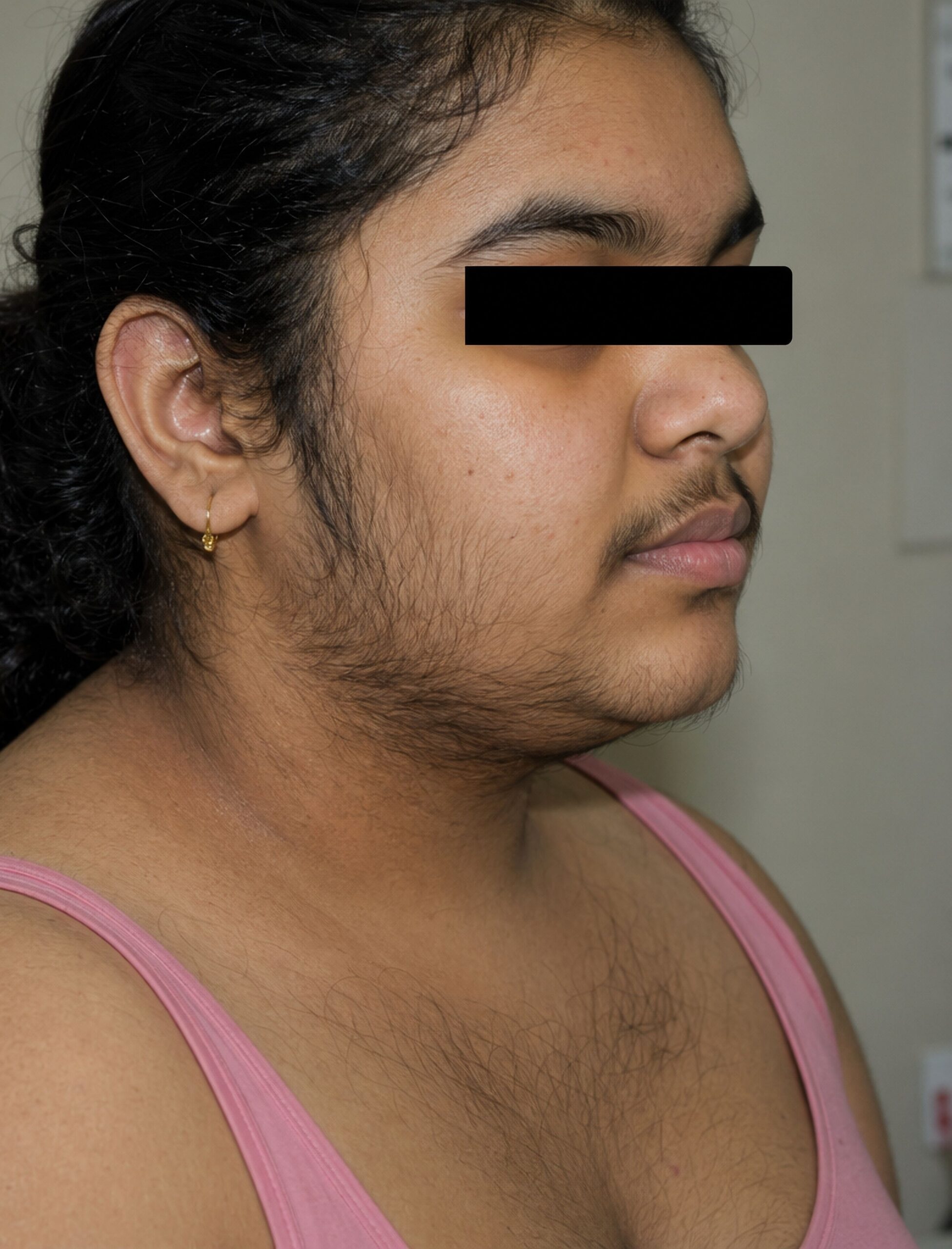
Hirsuitism on women’s face and neck
The Complete Guide to Hirsutism, Hair Removal, and Lasting Results
What’s driving the growth, where it appears, how to measure it, what removal actually takes — and how to build a treatment plan that works long-term
If you have PMOS and you’ve been fighting unwanted hair for years, you already know that ordinary hair removal doesn’t keep up. You shave, it’s back in days. You wax, it returns within weeks. You’ve probably spent hundreds — maybe thousands — of dollars and countless hours just staying ahead of it.
What most of those methods never addressed is the reason the hair keeps growing back: a hormonal and metabolic signal that is continuously activating hair follicles throughout your body. Until you target the follicle itself, you are managing a symptom, not solving the problem.
This guide is for women with PMOS who want to understand exactly what is happening with their hair — why, where, how severe — and what a real, structured treatment plan looks like to achieve lasting results.
SECTION 1
Why PMOS Drives Excess Hair Growth
It Starts With Insulin, Not Hormones
Most people think of PMOS as a hormonal condition. And while excess androgens are ultimately what drive the hair growth, the story starts earlier than that — with insulin resistance.
In women with PMOS, the body’s cells — particularly in the muscles, liver, and fat tissue — become resistant to insulin and stop responding to it efficiently. The body compensates by producing more and more insulin to get the job done. This chronically elevated insulin level is called hyperinsulinemia, and it sets off a two-part hormonal crisis that is at the root of PMOS-driven hair growth.
First, excess insulin travels to the ovaries, where it acts as a powerful stimulant. It works alongside the pituitary hormone LH to push the ovarian theca cells into overproducing androgens — particularly testosterone and androstenedione. Critically, the ovaries remain highly sensitive to insulin even when the rest of the body has become resistant to it. The signal gets through loudly and clearly: produce more testosterone.
Second, simultaneously, excess insulin suppresses the liver’s production of sex hormone-binding globulin — SHBG. SHBG is the protein that binds to testosterone in the bloodstream and keeps it biologically inactive. Think of it as testosterone’s off switch. When insulin is chronically elevated, SHBG production falls — meaning less of the testosterone circulating in the blood is bound and neutralized. More is free, active, and available to cause effects throughout the body.
The result is a perfect storm: the ovaries are producing more testosterone than normal, and the body has significantly less capacity to keep that testosterone in check. Free testosterone climbs steeply.
This is what makes PMOS so persistent. Insulin resistance drives androgen excess. Androgen excess worsens insulin resistance. Low SHBG amplifies both. The cycle feeds itself — continuously — and the hair keeps growing because the metabolic signal driving it never fully turns off.
From Testosterone to Terminal Hair: The Follicle Pathway
Those elevated free androgens travel through the bloodstream to hair follicles in androgen-sensitive areas of the body. There, they bind to androgen receptors within the follicle and trigger a transformation.
In a woman without hormonal excess, most body follicles remain in a resting state, producing only fine, colorless vellus hair — what most people call peach fuzz. When androgens bind to the follicle receptor, the follicle enlarges, the hair shaft thickens and darkens, and the hair becomes coarse terminal hair. Once a follicle converts to terminal type, it does not revert on its own. And as long as the androgenic environment remains active, previously dormant follicles continue to be recruited and converted.
An enzyme in the skin called 5-alpha reductase further amplifies this process by converting testosterone into dihydrotestosterone (DHT) directly at the follicle level. DHT is three to five times more potent than testosterone at activating follicle receptors. Women with high 5-alpha reductase activity can develop significant hirsutism even with only modestly elevated circulating androgen levels.
The Hair Growth Cycle and Why It Matters for Treatment
Every hair follicle cycles through three phases independently of neighboring follicles:
- Anagen (active growth): The follicle is actively producing a hair shaft. This phase lasts 4-6 months on the face and body. Only hairs in anagen can be effectively targeted by laser or electrolysis.
- Catagen (transition): A brief 2-3 week regression phase where growth stops and the follicle shrinks.
- Telogen (resting): The hair is retained but the follicle is dormant for approximately 3 months before the cycle restarts.
At any given time, only 20-30% of follicles in a treatment area are in anagen. This is why multiple sessions are required regardless of method: each session targets the cohort of follicles currently in active growth. The remaining follicles must cycle into anagen before they can be treated.
In PMOS patients, androgens continuously convert dormant vellus follicles into new active terminal follicles throughout the treatment period. This is not treatment failure — it is the biology of an active hormonal condition, and it is why PMOS patients require more sessions and longer-term maintenance than non-hormonal patients.
SECTION 2
Evaluating the Patterns: The Ferriman-Gallwey Assessment
Before building any treatment plan, we need to understand the full picture of what we are working with. The tool used by hair removal specialists and endocrinologists alike is the modified Ferriman-Gallwey score (mFG) — the gold standard clinical measurement for hirsutism severity.
The mFG scale evaluates nine specific body areas known to be androgen-sensitive. Each area is scored from 0 to 4:
- 0 — No terminal hair present
- 1 — Minimal, sparse terminal hair
- 2 — Moderate growth, covering less than half the area
- 3 — Heavy growth, covering more than half the area
- 4 — Complete, dense terminal hair coverage across the full area
The nine areas assessed are:
Upper lip — mustache-distribution hair along the vermillion border
Chin — terminal hair on the chin and lower jaw
Chest — hair between the breasts and on the upper chest
Upper back — hair across the upper back and shoulders
Lower back — hair across the lower back and sacral region
Upper abdomen — hair above the navel, midline and lateral
Lower abdomen — hair below the navel, midline strip toward pubic area
Upper arm — terminal hair on the outer upper arm
Thigh — hair on the inner and outer thigh
A combined score of 8 or above is the widely accepted clinical threshold for diagnosing hirsutism in most populations. Ethnic variation matters: women of East Asian heritage may show significant androgen-driven growth at lower scores, while women of Mediterranean or South Asian descent may score higher without it being clinically abnormal for their background.
A score of 8-12 reflects mild-to-moderate PMOS-driven hirsutism. Scores of 15-20 indicate significant androgenic activity across multiple zones. Above 20, the hormonal environment is strongly active — and the treatment plan must account for ongoing new follicle activation throughout the entire course of care.
In our practice, the mFG assessment serves two purposes. Clinically, it tells us the severity of androgenic activity and helps us build a treatment plan scaled to the patient’s actual needs. Personally, it validates what the patient has been living with. Many women have never had anyone systematically document every area where they are struggling. Going through the assessment together is often the first time a patient feels truly seen.
We document the mFG score at the start of treatment and reassess at each key milestone. It gives us an objective measure of progress — and an early warning signal if new areas are being recruited by ongoing androgenic activity.
SECTION 3
PMOS Hair Growth: Areas, Appearance, and Density
PMOS-driven hirsutism follows a characteristic androgen-dependent distribution. Below is a detailed breakdown of each commonly affected zone — what the hair typically looks and feels like, how dense it tends to be, and what patients most often report.
The Face
Upper Lip
One of the earliest and most common areas of PMOS hirsutism. Hairs typically begin as fine, dark vellus along the vermillion border and progress to coarse, thick terminal hairs as androgen exposure continues. In moderate-to-severe PMOS, the mustache distribution can extend to the corners of the mouth and toward the philtrum.
Density and regrowth: Moderate to dense. Regrowth after shaving typically visible within 24-48 hours in active cases.
Chin and Jawline
Terminal hairs on the chin range from scattered individual hairs to dense patchy coverage across the lower mandible and down the anterior neck. The jawline is a particularly common secondary site after the upper lip. In severe cases, terminal hair can bridge across the chin in a full beard distribution.
Density and regrowth: Variable — sparse scattered hairs to dense patches. Chin hairs are among the deepest-rooted facial hairs and among the most resistant to treatment.
Sideburns and Preauricular Area
Terminal hair extending from the temporal hairline downward along the cheek toward the jaw. Often overlooked in initial consultations but bothersome for many women, particularly in styles that expose the sides of the face.
Cheeks
Less common but present in moderate-to-severe PMOS. Hair typically extends from the sideburn area inward across the cheeks. This distribution is associated with higher androgen levels and often correlates with significant growth in other body areas as well.
Neck
The anterior neck is a natural extension of chin and jawline growth. Terminal hair on the neck is particularly distressing because it is difficult to conceal with clothing and highly visible. Posterior neck growth along the hairline is also common, particularly in women with significant scalp-to-neck extension.
Chest and Breast Area
Periareolar hair — terminal hairs around the nipple and areola — is extremely common in PMOS and dramatically underreported. Many patients have never mentioned it to a clinician or specialist because of embarrassment. It is among the areas patients report the most relief from treating.
The midline sternum often develops a strip of coarse hair that connects the chest to the abdomen. In moderate-to-severe cases this can extend laterally across the upper chest and décolleté.
Abdomen
The classic PMOS abdominal pattern is a midline vertical strip running from the sternum to the pubic area — the linea alba distribution. Unlike the typical female pattern of pubic hair forming an inverted triangle, PMOS shifts this toward a male diamond or vertical pattern extending upward toward and beyond the navel.
Hair density varies considerably: some women present with a fine midline strip while others have broader coverage extending laterally. The periumbilical area around the navel is frequently involved.
Lower Back and Buttocks
Terminal hair on the lower back, particularly in the sacral and lumbosacral region, is a consistent PMOS finding that is rarely discussed but commonly seen in practice. Upper buttock hair extending from the lower back is also present in moderate-to-severe cases.
Inner Thighs and Bikini Area
The inner thigh is one of the most hormonally sensitive hair growth zones in women. PMOS characteristically produces dense, coarse hair on the medial thigh extending toward the bikini line, often in a distribution more similar to male inner thigh hair than the typical female pattern. The inguinal crease area is also commonly involved, with hair extending beyond the standard bikini boundary.
Arms and Legs
Women with PMOS frequently note distinctly coarser, darker forearm hair and more rapid leg regrowth compared to before their hormonal symptoms developed. The forearm in particular is an androgen-sensitive area that can show significant PMOS-related changes over time.
The more areas involved simultaneously, and the faster the regrowth after removal, the more active the androgenic signal. This pattern tells us the hormonal environment is strong and should ideally be addressed medically alongside hair removal treatment for the best long-term results.
SECTION 4
Hair Longevity, Regrowth, and What ‘Permanent’ Really Means
One of the most important conversations we have with PMOS patients is about expectations — particularly around the words “permanent” and “permanent reduction.” These terms mean specific things in hair removal, and understanding them prevents frustration and dropout.
Laser Hair Removal: Long-Term Reduction
The FDA classifies laser hair removal as achieving “permanent hair reduction” — a significant, long-term reduction in the number of terminal hairs in a treated area. For most non-hormonal patients, this can approach near-total clearance with a standard course of treatment.
For PMOS patients:
- Treated follicles that are successfully destroyed will not regrow hair. That result is permanent.
- However, androgens can continue converting previously dormant vellus follicles into new active terminal follicles — follicles that were not present or active at the time of earlier sessions. These represent new growth driven by ongoing hormonal stimulation, not treatment failure.
- The degree of new activation depends heavily on androgen levels. Patients managing PMOS hormonally typically see significantly better long-term results than those with unmanaged hormonal activity.
Electrolysis: True Permanence at the Follicle Level
Electrolysis destroys the individual follicle with electrical current. A properly treated follicle will not regrow hair. The FDA recognizes electrolysis as the only method of true permanent hair removal.
The same caveat applies to PMOS: electrolysis permanently eliminates the follicles it treats, but cannot prevent new follicles from being hormonally activated in the future. This is why ongoing maintenance is part of the long-term plan for most PMOS patients regardless of method.
Typical Regrowth Timelines by Area
These timelines help set session spacing and patient expectations, and serve as a baseline against which to measure treatment progress:
- Upper lip and chin: Visible regrowth within 1-3 days of shaving in active PMOS; full regrowth cycle 2-4 weeks
- Neck and jawline: Similar to facial pattern, 2-4 week visible regrowth cycle in active cases
- Chest and abdomen: 4-6 week regrowth cycle typical
- Inner thighs and bikini: 3-5 week regrowth cycle
- Lower back: Slower cycle, typically 6-8 weeks between visible regrowth
As sessions accumulate, regrowth should become progressively finer, slower, and less dense. Tracking this change against the baseline mFG score gives both specialist and patient an objective view of how treatment is working.
SECTION 5
Laser Hair Removal for PMOS: How Diode Laser Works
The Science of Diode Laser at 810nm
Our practice uses diode laser technology operating at an 810nm wavelength. This wavelength sits in the near-infrared spectrum and is specifically optimized to target melanin — the pigment that gives hair its color — within the hair shaft and follicle bulb.
When laser energy is absorbed by the melanin in the follicle, it converts to heat. That heat damages the follicular stem cells in the bulge region and the dermal papilla — the blood supply structure at the base of the follicle. Sufficient thermal damage prevents the follicle from producing new hair.
The diode laser has specific advantages for PMOS patients:
- 810nm penetrates deeper into the dermis than shorter wavelengths, reaching the deeper follicle bulbs that coarse PMOS terminal hair tends to have
- Effective across a broad range of skin tones (Fitzpatrick types I-V) with appropriate fluence and cooling adjustments
- Longer pulse durations available on diode platforms are well-suited to the coarser, more pigment-dense terminal hairs produced by PMOS androgen activity
- Integrated cooling systems allow higher fluences to be delivered safely, improving efficacy on dense PMOS growth areas
Why PMOS Hairs Respond Well to Diode Laser
There is a counterintuitive advantage to PMOS hair: the androgens that drive hirsutism also make the hairs better laser targets. Coarser, darker, more deeply pigmented terminal hairs absorb laser energy more efficiently than fine vellus hairs. The very hairs that are most problematic for PMOS patients are the ones diode laser is best equipped to destroy.
The challenge is the ongoing hormonal activation of new follicles — which is precisely why the treatment schedule and maintenance plan are just as important as the individual session.
Skin Tone Considerations
Diode laser at 810nm can be safely and effectively used across a wide range of skin tones with appropriate parameter adjustments. For patients with deeper skin tones (Fitzpatrick IV-VI), longer pulse durations, lower fluences, and more aggressive cooling protect epidermal melanin while still effectively targeting the follicle. In cases of very deep skin tones where diode carries elevated risk, we will discuss the most appropriate options at consultation.
SECTION 6
Electrolysis for PMOS: Permanent Destruction, Follicle by Follicle
Electrolysis inserts a fine probe into the natural opening of the hair follicle and delivers a controlled electrical current directly to the follicle base. Three modalities are used:
- Galvanic electrolysis: Direct current that produces a chemical reaction at the follicle base, destroying tissue chemically. Highly thorough but slower per follicle.
- Thermolysis (shortwave diathermy): High-frequency alternating current that generates localized heat within the follicle. Faster than galvanic; requires precise technique and probe placement.
- Blend: A combination of both modalities, offering the chemical action of galvanic with the speed of thermolysis. Preferred in many clinical settings for its thoroughness on stubborn, deeply rooted terminal hairs — exactly the type PMOS produces.
When Electrolysis Is the Right Choice for PMOS Patients
For PMOS patients specifically, electrolysis plays a critical role in several scenarios:
- Facial precision areas — the upper lip, individual chin hairs, and the hairline — where follicle-by-follicle targeting delivers superior results
- Lighter or finer hairs that lack sufficient melanin for laser to target effectively
- Post-laser finishing: after laser has cleared the bulk of dense growth, electrolysis addresses the remaining scattered hairs that laser did not fully resolve
- Patients with skin tones where laser carries elevated risk
- Areas where absolute permanence is the priority and the patient is prepared to invest the time
Managing Expectations With Electrolysis and PMOS
Electrolysis on PMOS-driven hirsutism is highly effective but requires patience. Dense facial growth in an active hormonal environment means that new hairs can emerge between sessions, creating the perception of incomplete clearance. Patients should understand that these are newly activated follicles responding to ongoing androgen stimulation — not regrowth from treated follicles.
With consistent treatment and, ideally, concurrent hormonal management, most patients see progressive and significant clearing over 12-18 months of regular electrolysis on the face.
SECTION 7
Treatment Schedule: How We Structure Your PMOS Hair Removal Plan
No two PMOS patients are the same. Androgen levels vary, affected areas differ, hair density and regrowth speed respond differently from person to person, and the degree to which hormonal activity is being managed medically changes the picture significantly. This is why we do not offer a fixed package with a set number of sessions. Instead, we build and continuously refine a treatment plan that is specific to you — from your first session through long-term maintenance.
Phase 1: The Progressive Interval Protocol
The foundation of our PMOS treatment approach is what we call a progressive interval schedule. Rather than spacing every session at the same fixed interval, we deliberately extend the wait time between each treatment as the course progresses. This is not arbitrary — it mirrors the biology of the hair growth cycle and how follicle populations respond cumulatively to treatment.
Here is how the schedule is structured across all body areas:
Treatment Wait Before Next Session What We’re Doing
Treatment 1 8 weeks Targeting the first cohort of anagen follicles across all active areas
Treatment 2 10 weeks Catching the next wave of follicles cycling into anagen
Treatment 3 12 weeks Follicle populations thinning — longer interval allows more to cycle in
Treatment 4 14 weeks Density reducing; interval extended to capture slower-cycling follicles
Treatment 5 16 weeks Assessment point; evaluating what remains and planning next phase
The logic behind the expanding interval is straightforward. After each treatment, the total number of active follicles in the area decreases. As density reduces, the remaining follicles need more time to cycle into the anagen phase where they can be effectively targeted. Extending the interval at each step means we are treating a more complete cohort at each session rather than returning too soon and missing follicles that have not yet cycled in.
Think of it this way: early in treatment, the area is dense with active follicles and shorter intervals make sense. As treatment progresses and density drops, the remaining follicles are more spread out in their cycling. A longer wait captures more of them in a single session — making each visit more efficient and effective than the last.
This schedule applies to all body areas being treated. Because PMOS often involves multiple zones simultaneously — face, chest, abdomen, thighs, back — we coordinate the timing across areas so that your visits are as productive as possible and your overall treatment calendar makes sense for your life.
Continuous Reassessment: We Adjust at Every Visit
Unlike a fixed protocol, our approach treats every appointment as both a treatment session and an evaluation. There is no waiting until a predetermined endpoint to ask whether things are working. We are assessing continuously — and adjusting continuously.
At each visit, we evaluate:
- Hair density and regrowth speed in all treated areas compared to the previous visit
- The caliber of regrown hair — whether it is finer and lighter than before, which signals successful follicle damage, or returning at full coarseness, which tells us we need to adjust our approach
- Whether new areas are being recruited by ongoing androgen activity that were not active at the start of treatment
- Your comfort and skin response to current settings, which informs whether parameters can be pushed further for better efficacy
Based on what we find, we make real-time adjustments including:
- Energy levels (fluence): increased as your skin’s tolerance builds and remaining follicles become more resistant, or adjusted if skin sensitivity warrants
- Laser handpiece selection: different handpieces within our diode system deliver varying spot sizes, pulse durations, and cooling profiles — we match the handpiece to what the area and hair type need at that specific point in treatment
- Session interval: if regrowth is faster than expected or new follicle activation is significant, we may tighten the interval; if the area is responding exceptionally well, we may extend it further
- Modality: if specific hairs are not responding to laser — typically lighter, finer, or more deeply rooted individual hairs — we transition those follicles to electrolysis for permanent individual destruction
We do not believe in a one-size-fits-all protocol for PMOS patients. What works beautifully for one person’s upper lip may need to be completely different for another’s chin or inner thigh. Our job is to pay close enough attention at every visit to know the difference — and act on it.
Pre-Appointment Growth Checks
One of the things that sets our PMOS treatment approach apart is that we sometimes ask patients to come in the week before their scheduled appointment for a brief growth check. This is not a treatment visit — it is an observation visit, and it takes only a few minutes.
Why do we do this? Because in PMOS, the timing of hair cycles can shift as treatment progresses and hormonal conditions change. By looking at the growth pattern the week before your appointment, we can:
- Confirm that the current interval is correctly timed — that there is enough active anagen growth present to make the upcoming session maximally effective
- Identify whether the interval needs to be shortened or extended before we commit to it for this cycle
- Spot any new areas of activation early so we can incorporate them into the treatment plan at the next visit rather than discovering them mid-session
- Adjust preparation instructions — for example, if growth is lighter than expected, we may ask you to hold off shaving for a few additional days before your appointment
Not every patient will need pre-appointment checks at every stage — but for patients in the early phases of treatment, those with highly active hormonal profiles, or those at transition points in their plan, this extra touchpoint gives us information that meaningfully improves the precision of your treatment.
Phase 2: Maintenance
Maintenance is the phase most often underexplained to PMOS patients — and the one that determines whether your results last. Even after achieving significant clearance, the underlying hormonal environment of PMOS means that new follicle activation can continue over time. Maintenance sessions stay ahead of that activation before it re-establishes into dense growth.
Maintenance frequency is tailored to your hormonal status and how you are responding:
- Unmanaged or partially managed PMOS: maintenance sessions every 8-12 weeks to address ongoing new follicle activation
- Well-managed PMOS with medical hormonal treatment: maintenance sessions every 4-6 months, often reducing to once or twice yearly as androgen levels stabilize
- Post-menopausal PMOS patients: as androgen levels naturally decline, many patients reach a point where maintenance needs are minimal or resolve entirely
The goal of maintenance is not to repeat your initial course. It is to address a small and manageable number of newly activated follicles before they establish into a problem. A handful of maintenance visits each year is far less burdensome — and far less costly — than allowing growth to re-establish and starting over from the beginning.
We continue to reassess at every maintenance visit. If your hormonal picture changes, if you begin or adjust medical management, or if new areas of activation appear, we update the plan accordingly. Your treatment with us is never finished and forgotten — it evolves with you.
A Note on What This Commitment Looks Like
We want to be fully transparent with every PMOS patient: this is not a six-session fix. PMOS is an ongoing hormonal condition, and achieving lasting hair removal results in that environment requires a genuine partnership — your commitment to the schedule, our commitment to continuously refining your plan, and ideally a parallel commitment to addressing the hormonal root cause with your physician.
What we can promise is that every visit matters, every adjustment is purposeful, and every decision we make is based on what we are actually seeing in your treatment — not on a predetermined formula. That is the only approach that works for PMOS.
SECTION 8
The Integrated Approach: Hair Removal and Hormonal Management
The most effective PMOS hair removal outcomes we see consistently involve patients who are also addressing the hormonal and metabolic side of their condition with their physician or endocrinologist.
Medical management of PMOS — which may include combined oral contraceptives, spironolactone, metformin, or other agents depending on the patient’s clinical picture — does not remove existing terminal hair. But it does reduce the rate at which new follicles are activated, which directly improves hair removal results by:
- Reducing the number of new hairs appearing between sessions
- Allowing treated areas to stay clear for longer between maintenance visits
- Improving the long-term trajectory of treatment: gradual, sustained reduction rather than a cycle of clearance and re-activation
We do not require patients to be under hormonal management before starting hair removal. Many patients come to us before they have seen a specialist, and treatment proceeds effectively in parallel. We do, however, strongly encourage every PMOS patient to discuss hormonal and metabolic management with their physician, and we are happy to communicate with their care team about what we are observing in the treatment area.
You Don’t Have to Keep Managing This Alone
PMOS-driven hirsutism is a metabolic condition rooted in insulin resistance and hormonal imbalance. The hair is growing because your metabolic environment is telling it to. Treating it effectively means understanding the biology, documenting the full picture with a proper assessment, building a structured plan scaled to your actual needs, and having a specialist who understands what you are dealing with.
We work with PMOS patients every day. We understand the frustration, the time and money it has already cost you, and what real, lasting results look like. If you’re ready to stop managing and start resolving, we’d love to talk.
Book a complimentary consultation — we’ll map your growth areas with a full Ferriman-Gallwey assessment, review your history, and build a treatment plan specific to you.