



There is nothing wrong with you.
If dark, coarse hairs have started appearing on your chin, jaw or upper lip, you’ve probably wondered whether it’s somehow your fault. It isn’t. Your hormones have shifted, and your follicles have responded exactly as follicles do.
This is one of the most common changes of perimenopause and menopause. It’s also one of the least discussed. Women get warned about hot flashes. Almost no one mentions this — so when it happens, it feels like a personal defect instead of ordinary biology.
Here’s what’s actually going on, where the hair tends to show up, why it affects women as much as it does, and what the options are.
It usually starts earlier than women expect
Most women date menopause from their last period. The hormonal changes behind it start years earlier.
That stretch is called perimenopause. It commonly begins in the mid-forties, sometimes earlier, and can last anywhere from a few years to a decade — with periods arriving more or less on schedule the whole time. Which is exactly why the connection gets missed.
Hormones don’t decline in an orderly way during this stretch. They swing. And there can be long periods where the balance tips toward androgens and their effects start to show — a coarser hair or two on the chin, a change in texture — while everything else still looks normal from the outside.
Women in this age group are often told they’re too young for this, or that a few chin hairs are nothing. Both responses miss the point. It’s a reasonable thing to raise with a doctor at 42, not something to sit on until 55.
One caveat: if you’re under 40, don’t assume menopause is the explanation. Other causes are considerably more likely at that age, and several of them are treatable — PMOS (formerly known as PCOS), thyroid conditions, and medications or supplements you may be taking. Carrying extra weight can contribute too, though not in the way most people assume. Body fat affects how your body handles insulin, and higher insulin levels lower the protein that normally keeps testosterone bound and inactive — which leaves a greater share of it free to act. The picture isn’t one-directional, though: after menopause, body fat is also where most of your remaining estrogen is produced. That’s part of why weight loss on its own rarely resolves hair that has already developed. It’s a real factor, it isn’t a moral failing, and it’s something your doctor can help you think about in context.
It’s also worth saying that normal is not the same for everyone. Baseline hair density varies considerably between ethnic groups: women of South Asian, Middle Eastern and Mediterranean heritage typically have more facial and body hair than average, and women of East Asian heritage typically less. That isn’t a cause of anything — it just means the threshold for what counts as unusual is different from person to person, and that a comparison with your friends tells you very little.
Why it happens
The short version: it isn’t that your body has suddenly started producing a lot of male hormone. It’s that the hormone balance you’ve had your entire adult life has changed.
Estrogen falls away across the menopausal transition. Androgens — the group that includes testosterone, which every woman produces and needs — behave differently. They drift down slowly with age rather than dropping off, and in most women they don’t rise at all. So what changes usually isn’t how much you have. It’s that there’s far less estrogen to offset it, and effects that were always possible start to show.
Three things then largely determine how much hair you actually get.
How much testosterone is free to act. Much of the testosterone in your bloodstream is bound up and unavailable to your tissues. Estrogen keeps levels of the protein that does that binding high. As estrogen falls, that protein falls too — so more of your testosterone becomes available to act, even though the total amount hasn’t changed much.
This is why a standard blood test can come back completely normal while all of this is happening to you. The usual test measures total testosterone, and your total may be perfectly ordinary. If you’ve been told your levels are fine and left feeling like you must be imagining things, this is the reason. You aren’t. (It’s worth asking your doctor about it directly — there are more specific tests available.)
How sensitive your follicles are. This is strongly influenced by genetics, and it varies enormously. Two women with identical hormone levels can end up with completely different amounts of hair. If your mother or aunts developed facial hair after menopause, you’re more likely to.
What kind of hair the follicle was already making. Your face is covered in fine, pale, essentially invisible hair. Under androgen influence, some of those follicles switch over to producing thick, dark, deep-rooted hair instead, and that switch doesn’t reverse on its own.
This is worth understanding clearly, because it explains something frustrating. When you pluck or shave, you remove the hair — but the follicle underneath is untouched, and it’s still programmed to make terminal hair. So it grows the same coarse hair back, again and again. Temporary methods deal with the hair. The follicle is what’s actually changed.
Two other things worth knowing
The frustrating paradox. Many women grow coarse hair on the face while their scalp hair thins at the crown and part line, and while leg and underarm hair gets softer and sparser. It seems contradictory. It isn’t: the same hormones stimulate hair in some areas and shrink it in others. Shaving your chin daily while worrying about your part line is a completely coherent experience.
Your skin has changed too. After menopause, skin becomes thinner and drier, heals more slowly, and marks more easily — particularly in deeper skin tones. Methods you tolerated fine at 30 can leave redness, bruising or lasting dark marks at 55. Any hair removal plan has to account for your skin, not just your hair.
Where the hair tends to show up
The pattern is remarkably consistent — which is reassuring in itself, if you’ve been assuming yours is unusual.
Face and neck, the areas women find most distressing:
- Chin and jawline, often as single very coarse hairs
- Upper lip, from a faint shadow to defined dark hair
- Sideburn area and in front of the ears
- Cheeks and along the “beard line”
- Front and sides of the neck, and under the chin
- Coarse strays in the eyebrows, and occasionally the nose or ears
Body:
- Chest and around the nipples
- The midline between pubic bone and navel
- Lower and sometimes upper back
- Upper arms and shoulders
- Inner thighs and buttocks
- A change in the shape and spread of pubic hair
Texture changes. Even where hair already existed, it can become coarser, darker, wirier or curlier, grow back faster, and stop responding to the methods that used to work.
Why this hits harder than people assume
This is the part that gets left out of most articles, and it deserves as much space as the biology.
Facial hair on a woman carries a specific weight, because it sits right on the line of how femininity gets read. Research on excess hair growth consistently finds real effects on quality of life, anxiety and mood — and, notably, distress doesn’t track the amount of hair. A woman with very little can be profoundly affected. What matters is what it means to her.
Shame and secrecy. Many women manage this entirely alone, hiding it from partners of thirty years. It’s one of the few midlife changes that never comes up in the group chat, which keeps everyone convinced they’re the only one.
Identity. Arriving alongside the end of fertility, a changing body and thinning hair, this can feel less like a cosmetic issue and more like becoming someone you don’t recognize.
Checking. Magnifying mirrors. Phone cameras. Touching the chin over and over. Every car mirror and shop window. Some women check dozens of times a day, and plucking can turn into an hour-long compulsive session that leaves the skin damaged — closer to a nervous ritual than grooming.
Avoidance. Skipping the pool, the gym, the sauna. Avoiding bright daylight, sitting by windows, being seen in profile. Turning down intimacy, or avoiding overnight stays and vacations for fear of being seen unmanaged.
The load. Removal before work. Maintenance before every social event. The ongoing cost. The knowledge that you can never stop.
Anger. At the unfairness of it, at not being warned, and at the fact that nearly everything written about excess hair growth is aimed at women in their twenties.
Waiting too long to ask. Embarrassment means many women say nothing for years, and report being brushed off when they finally do. Being taken seriously is often the most valuable part of a first consultation.
None of this is vanity. It’s a reasonable response to a visible change in a part of the body that carries a lot of social meaning.
What women try: the temporary methods
Most women work through several of these, usually in escalating frustration. Each has a place, and each has limits — particularly on more fragile skin.
Plucking and tweezing. The default for stray chin hairs. Regrowth in two to six weeks. Repeated trauma causes ingrown hairs, dark marks, and distorted follicles that make later treatment harder. It’s also the method most likely to become compulsive.
Shaving. Fast, cheap, and it does not make hair grow back thicker — that myth comes from the blunt cut end feeling stubbly. Regrowth shows within a day or two, and it can irritate thin, dry skin.
Waxing and sugaring. Pulls hair from the root, so results last two to five weeks. On mature skin, and especially if you use retinoids, wear hormone patches nearby, or take blood thinners, hot wax carries a genuine risk of lifting skin, bruising and leaving marks. Sugaring is gentler.
Threading. Precise, and popular for the lip and brows. No chemicals or heat, but sore over larger areas.
Depilatory creams. Dissolve hair at the surface. Painless, but strong-smelling and a common cause of reactions on facial skin. Always patch test.
Epilators. Mechanical mass-plucking. Lasts longer than shaving, uncomfortable, and prone to causing ingrowns.
Dermaplaning. Removes fine surface hair and dead skin with a blade. Great for smoothness and makeup application; doesn’t do much about coarse hairs and needs frequent repeating.
Bleaching. Lightens rather than removes. Fine for a faint upper lip; ineffective on coarse hair.
Abrasive pads and buffing mitts. Sand hair off at the surface. Harsh on thinning skin and a reliable way to cause dark marks.
Trimming. Discreet and gentle. Also the shortest-lived.
Prescription options. Doctors can prescribe topical treatments that slow facial hair growth and oral medications that act on androgens. These take months to show any effect and slow new growth rather than removing hair that’s already there — so they’re used alongside physical hair removal, not instead of it. Ask your doctor.
The pattern women eventually notice
Every method above manages the hair. None of them changes the follicle. Because that vellus-to-terminal switch doesn’t undo itself, temporary removal becomes a permanent commitment — often for thirty years or more. Realizing that is usually what sends women looking for something definitive.
For lasting change there are two real options, and they’re often best used together.
Laser is by far the faster of the two. It treats a whole area in a single pass rather than hair by hair, so a full face takes minutes, and most women see meaningful thinning over a course of sessions spread across a number of months. What it delivers is permanent hair reduction rather than removal — significantly less hair, finer and lighter than before. The limitation is that it relies on pigment: it works best on dark hair, and does little or nothing for gray, white or very fair hair.
Electrolysis is the only method recognized as permanent hair removal, and the only one that works regardless of hair color — including the gray and white hair that becomes common at exactly this age. The honest trade-off is time. It treats one follicle at a time, which means repeated appointments over many months to several years, depending on how much hair there is and how widespread it is. It is genuinely slow, and anyone who tells you otherwise is overselling it.
Used together, they cover each other’s weaknesses: laser to clear the bulk of dark hair quickly, electrolysis to finish the hairs laser can’t see. Which combination makes sense depends on how much hair you have, how much of it has grayed, and your skin tone — which is what a consultation is for.
When to see a doctor promptly
Gradual hair growth developing over several years around menopause is typical. Get medical advice sooner if you notice:
- Hair appearing rapidly, over weeks or a few months
- A marked increase well after menopause is established
- A deepening voice, significant scalp hair loss, or increased muscle bulk
- Unexplained weight change, easy bruising, or new high blood pressure
- Periods stopping before age 40 alongside new hair growth
These are uncommon, but they’re worth ruling out. A good hair removal practitioner will always encourage medical investigation alongside treatment — never instead of it.
The message worth ending on
This is common, it’s biologically explicable, and it isn’t a reflection of anything you’ve done. It’s not a hygiene issue, not a weight issue, and it isn’t vanity to want it dealt with.
If it’s affecting your daily life — how you dress, where you go, who you let close — that’s reason enough to get help. A good consultation means someone looking properly at your hair, your skin, your pattern of growth and your history, and being honest with you about what each option can and can’t achieve.
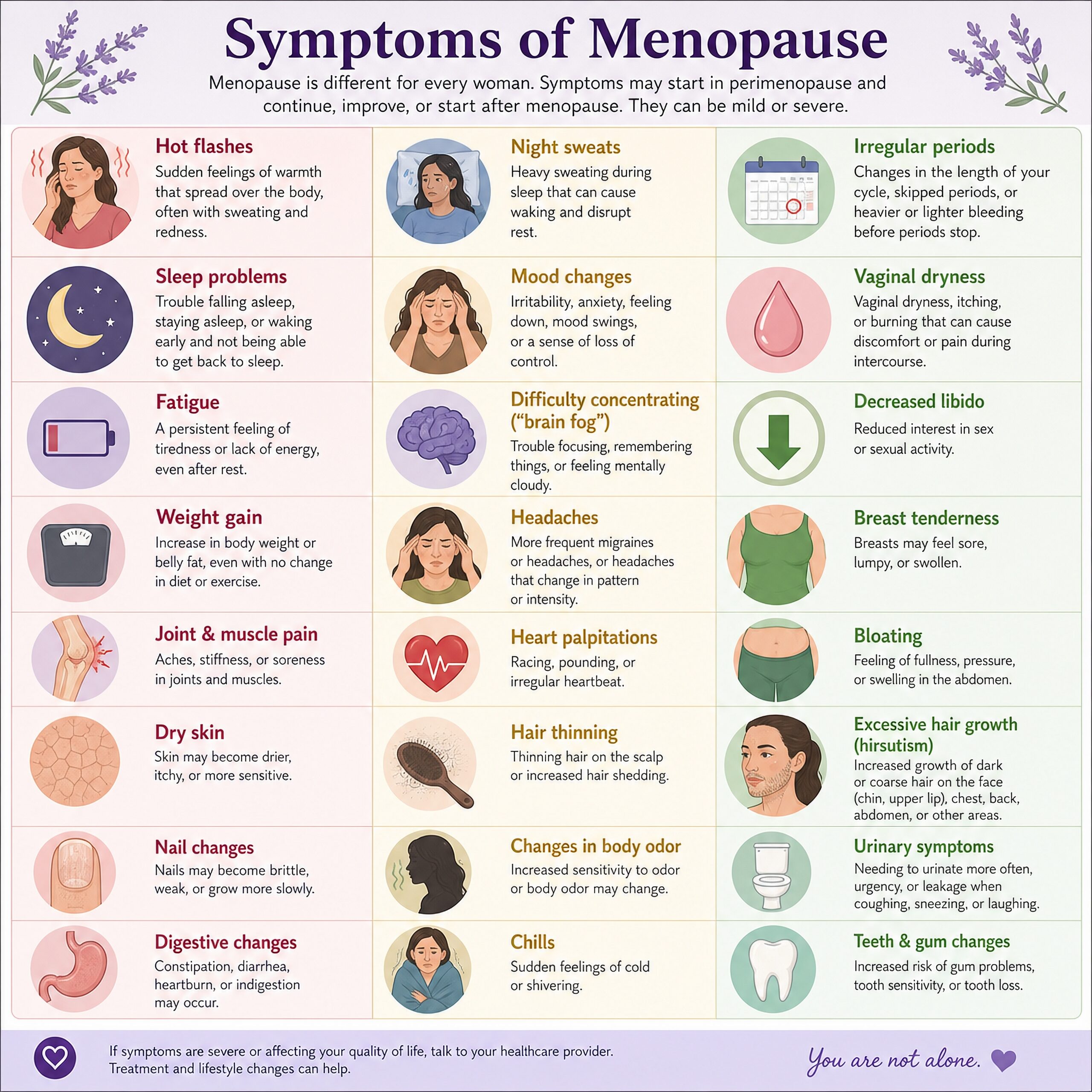
Menopause symptoms