



 By Debra Nazarian CPE, LE | Associates In Electrology & Advanced Laser Therapy | 41 Years Specializing in PMOS-Related Hair Removal
There is a conversation I have had thousands of times over the past 41 years. A woman sits down across from me, and before she even describes her hair growth, I can read something in her expression — a combination of exhaustion, embarrassment, and a quiet resignation that this is simply her life now. She has shaved this morning. She shaved yesterday. She will shave tomorrow. She has tweezed before leaving the house, waxed before a special occasion, and spent more time and money than she can calculate trying to stay ahead of something that never stops.
She has tried laser treatments and was told she was “done,” only to watch the hair return within months. She has been dismissed by doctors, handed pamphlets, and sent on her way. She doesn’t understand why, no matter what she does, the hair keeps coming back.
After four decades in this field, I finally have a better answer for her.
Why This Hair Is So Relentless
To understand why GLP-1 medications matter so much for women with PMOS, you first need to understand why the hair keeps coming back in the first place — because it is not random, and it is not a treatment failure.
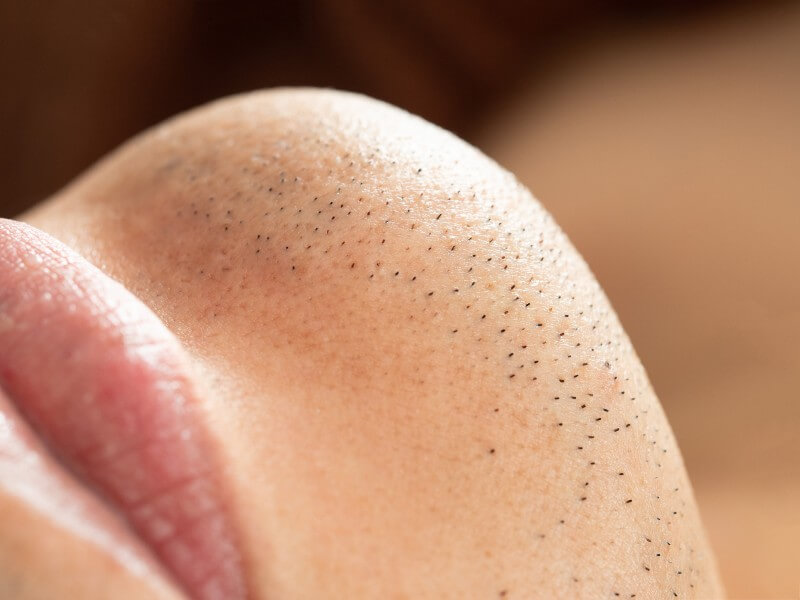
PMOS is driven at its core by insulin resistance. When cells resist insulin’s signal, the body compensates by producing more and more of it. Chronically high insulin then signals the ovaries to overproduce androgens — male hormones like testosterone. Those elevated androgens circulate through the body and continuously stimulate hair follicles in androgen-sensitive areas: the chin, upper lip, jawline, neck, chest, and abdomen. The hair that grows is not fine and light — it is coarse, dark, and deeply rooted.
Laser hair removal and electrolysis treat the hairs that exist right now. What they cannot do is stop the hormonal signal that keeps activating new follicles. As long as insulin resistance is driving excess androgens, new hair growth will continue to emerge — sometimes for decades. This is why PMOS-related hair removal has always felt like a battle with no finish line.
For my clients, this has meant years — sometimes a lifetime — of treatments, maintenance, and the emotional weight that comes with it. The shaving every day. The canceling plans. The avoiding intimacy. The quiet shame of something they never asked for and cannot fully control. I have sat with women in tears over this more times than I can count. It is not a cosmetic inconvenience. It is a profound quality-of-life issue, and it has always deserved better solutions than we had.
What GLP-1 Medications Are Actually Doing
GLP-1 receptor agonists — semaglutide (Ozempic, Wegovy) and tirzepatide (Mounjaro, Zepbound) — are widely known for weight loss. But for women with PMOS, what they do hormonally is the real story.
These medications improve insulin sensitivity at the root level. Less insulin circulating means the ovaries receive less signal to produce testosterone. And less testosterone means less ongoing stimulation of androgen-sensitive hair follicles. For the first time, many women with PMOS are experiencing a genuine shift in the hormonal environment that has been driving their symptoms — not just managing the hair after it appears, but reducing the body’s drive to produce it.
The research backs this up in meaningful ways:
Androgens drop measurably. GLP-1 therapy has been shown to reduce total testosterone and free testosterone — the specific hormones responsible for hirsutism — in women with PMOS. One meta-analysis of randomized controlled trials found a reduction in total testosterone of approximately 33%.
SHBG increases. Sex hormone-binding globulin is a protein that binds excess androgens and renders them inactive. GLP-1 medications stimulate the liver to produce more of it, further reducing the free testosterone available to trigger hair follicle activity.
Visceral fat decreases. The deep abdominal fat most tightly linked to insulin resistance and androgen overproduction responds particularly well to GLP-1 medications — often before major overall weight loss occurs — further improving the underlying metabolic environment.
Cycles often regulate. As insulin and androgen levels fall, many women with PMOS see their menstrual cycles become more regular — a strong signal that the hormonal environment is genuinely stabilizing.
What This Means in Our Treatment Room
This is the part I find most exciting — because I have spent 41 years wishing I had better news for my PMOS clients.
When a client is working with her healthcare provider on GLP-1 therapy alongside her laser or electrolysis treatments, the potential outcomes shift significantly:
Results hold longer. New hair growth slows in a real, meaningful way. Maintenance becomes less frequent. And the finish line — which for so many PMOS clients has felt impossibly far — starts to come into view.
I want to be honest: this is still an emerging area of research, results vary by individual, and GLP-1 medications are not appropriate for everyone. They require a prescription and should always be discussed with a qualified healthcare provider — an OB-GYN, endocrinologist, or primary care physician who understands PMOS. We are hair removal specialists, not prescribers, and we always encourage our clients to pursue comprehensive medical management alongside their treatments with us.
But the combination of effective hormonal management and professional hair removal is more powerful than either approach alone. And for a condition that has caused so much frustration and heartbreak over so many years, that combination feels like something worth talking about.
A Note on Hair Shedding
Some women taking GLP-1 medications notice scalp hair shedding. This is most commonly attributed to telogen effluvium — a disruption to the hair growth cycle that can be triggered by rapid weight loss or significant physiological change. While most evidence points to weight loss as the primary driver rather than the medication itself, research is still ongoing. What is important to know is that this type of shedding is entirely different from the androgen-driven hair growth PMOS causes, and it is generally considered temporary. If you notice it, mention it to your prescribing provider.
For Every Client Who Has Felt Like This Would Never Get Better
After 41 years, I know what it costs to live with PMOS-related hair growth — not just financially, but emotionally. I have seen how it affects the way women move through the world, and I have felt the weight of not always having a complete solution to offer.
That is changing. The tools available today — GLP-1 medications combined with laser hair removal and electrolysis — represent the most promising integrated approach we have ever had. For women who have been managing this condition for years, and who may have quietly given up on the idea of real, lasting improvement: there is genuine reason for hope.
We are here for every step of this journey — and for the first time in a long time, I believe that journey has a destination.
Ready to explore your hair removal options? We’d love to hear from you.
Associates In Electrology & Advanced Laser Therapy 2101 Mineral Spring Avenue, North Providence, RI 📞 401-232-5335 🌐 hairremovalri.com 📧 info@hairremovalri.com
Disclaimer: This post is for informational purposes only and does not constitute medical advice. GLP-1 medications require a prescription and should be discussed with a qualified healthcare provider.