



You started minoxidil because you were tired of watching your hair thin. But somewhere along the way, you noticed something new: hair growing on your forehead, cheeks, chin, or sideburn area.
If that sounds familiar, you’re not imagining it, and you’re far from alone. Over the last few years, several of our own clients have come to us with exactly this concern, and it’s a well-documented side effect of minoxidil, particularly the oral form. That also coincides with a documented jump in oral minoxidil prescribing for hair loss in 2022, including among women. Here’s what’s actually going on, and what your options are.
Why does minoxidil cause facial hair?
Minoxidil was originally a blood pressure medication. Hair growth turned out to be an unexpected side effect, which is why it’s now widely used for hair loss. The same effect that stimulates hair on your scalp can also stimulate growth elsewhere. This is called hypertrichosis: excess hair growth beyond what’s typical for a person’s age, sex, and background. It’s different from hirsutism, which refers to male-pattern hair growth in women driven by androgens.
For women, minoxidil-related hypertrichosis most often shows up on the face, and may include:
- The forehead
- The cheeks
- The chin
- The upper lip
- The sideburn area
- Sometimes areas beyond the face, such as the neck, arms, or legs (more likely with oral minoxidil)
The hair itself varies. It’s often soft and fine, but in some cases it can become darker and thicker. That’s one reason an in-person assessment matters when choosing a removal method.
How common is it?
How often it happens depends heavily on which form you use. Topical minoxidil is sold over the counter and is usually the starting point. The oral form requires a prescription and is used off-label for hair loss.
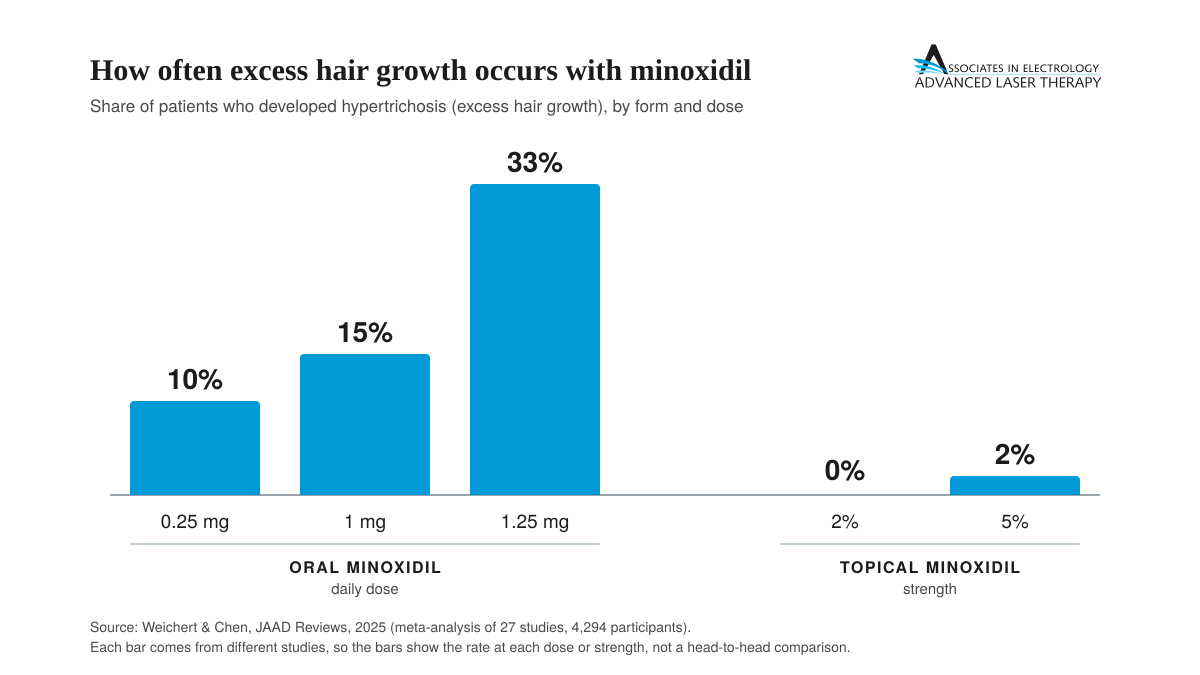
Oral minoxidil works throughout the body, so it’s more likely to cause hair growth beyond the scalp. A 2025 systematic review and meta-analysis covering 27 studies and over 4,000 participants found hypertrichosis in roughly 10% to 33% of people taking low-dose oral minoxidil, with rates rising with the dose.
Topical minoxidil carries a much lower risk. In that same analysis, rates were about 0% with 2% minoxidil and about 2% with 5%. Hair growth from topical minoxidil also tends to appear near where it’s applied.
Two other points are worth knowing:
- Dose matters. Research on oral minoxidil shows that higher doses are associated with a higher chance of hypertrichosis.
- Women report it more often than men. One review notes it tends to occur at lower doses in women, and that men may also simply notice or report it less.
Importantly, very few people stop treatment because of it. In the meta-analysis above, fewer than 1% discontinued minoxidil for this reason. Many people decide the benefit for their scalp is worth it, and that’s a completely reasonable choice.
Could it be coming from how you apply it?
Possibly, if you use a topical product. The product label for women’s topical minoxidil directs users to apply it only to the scalp and to wash their hands well afterward. It also says to stop use and ask a doctor if unwanted facial hair growth occurs. If you’re unsure about your technique, your doctor or pharmacist can review it with you.
Is this something to worry about?
The hair growth itself is not considered dangerous, and it’s often mild. But that doesn’t make it easy to live with. For many women, hair loss has already taken a toll on confidence, and new facial hair can feel like a frustrating trade.
One note: if you’re noticing coarse, dark hair in a male-like pattern (for example, along the jaw, chin, or chest), especially alongside irregular periods, acne, or other changes, mention it to your doctor. That pattern can have other causes, such as hormonal conditions, and is worth having evaluated.
What are your options?
1. Talk to your prescriber first. This should be your first step. Sometimes adjusting the dose or concentration can reduce the effect while preserving scalp results. Please don’t change or stop your medication without that conversation. It’s their call, and they know your full picture. Hair growth sometimes lessens after stopping minoxidil, but how long that takes varies widely, and it isn’t guaranteed to resolve completely.
2. Ask about medical options. Prescription eflornithine cream is FDA-approved to treat unwanted facial hair in women. It slows hair growth rather than removing hair, and it can take a month or two to see improvement. Hair returns to its pre-treatment state after you stop using it. A dermatologist can tell you whether it makes sense for you.
3. Temporary at-home methods. Shaving, threading, waxing, and depilatory creams are common choices. They’re inexpensive and work for many people, though results are short-lived and some skin types are more sensitive to them.
4. Professional hair removal. This is where we come in. Electrolysis and laser hair removal are the two professional approaches, and they work differently:
- Laser hair removal uses light that is absorbed by pigment in the hair, so it works on hairs with enough color to absorb it. Dark hair responds best, with a long-term reduction with little to no-hairs growing back. Light, gray, and blond hairs don’t absorb enough light, so they remain after laser and may need electrolysis to finish the job. That’s why laser is classed as permanent hair reduction. The FDA defines this as a long-term, stable reduction in the number of regrowing hairs, not the elimination of every hair in the area (since they could lack pigment).
- Electrolysis treats each follicle individually and works on any hair color, including light, gray, or blond hair. It’s considered a permanent method of hair removal, although it generally takes more sessions and can be a long process.
Which is right for you depends on your hair, your skin, the areas involved, and your goals. Some clients benefit really well with a combination of both methods. A proper assessment is the only way to know.
Excess hair growth and Menoxidil
One thing to keep in mind if you’re still using minoxidil
If you stay on minoxidil, new facial hair may continue to appear. That doesn’t mean hair removal isn’t worth pursuing, but it does mean timing and expectations matter. We’d rather talk this through honestly up front than have you feel discouraged later. A consultation will help us build a realistic plan around your situation.
Frequently asked questions
Will the facial hair go away if I stop minoxidil? Sometimes it lessens, but the timeline varies widely. In published case reports, some people improved within a few months and others were still improving many months later, with some hair persisting. Stopping may also mean losing your scalp results, so talk to your prescriber before making any changes.
Is the hair from minoxidil different from normal facial hair? It varies. It’s often soft and fine, but it can also become darker and thicker. Your hair type is a key factor in choosing the right removal method.
Will laser work on light facial hair? Usually not. Laser relies on pigment, so it generally can’t treat light, gray, or blond hair, while darker hair responds better. Electrolysis works regardless of hair color, so it’s often the better fit for light hair.
Do I need to stop minoxidil before hair removal? Please don’t stop on your own. Whether to change anything is a decision for your prescriber. We can talk through your current regimen at your consultation and explain what to expect.
Is this embarrassing to bring up? Not at all. It’s a recognized side effect, and it’s a concern several of our clients have brought to us. There’s no judgment here.
You’re not alone, and you have options
Treating hair loss shouldn’t cost you your confidence somewhere else. If minoxidil has left you with unwanted facial hair, we’d be glad to take a look, answer your questions, and help you decide on a path that fits your hair, your skin, and your comfort level.
Ready to talk it through? [Book a free consultation] at Associates in Electrology & Advanced Laser Therapy, and let’s uncover your confidence, one treatment at a time.
Associates in Electrology & Advanced Laser Therapy
This article is for general information and does not constitute medical advice. Please consult your doctor or dermatologist about your medication and any health concerns.
Sources
- Weichert M, Chen M. Efficacy and safety of minoxidil therapy: a systematic review and meta-analysis weighing the benefits against the risk of hypertrichosis. JAAD Reviews, 2025.
- Characterization and Management of Adverse Events of Low-Dose Oral Minoxidil Treatment for Alopecia: A Narrative Review.
- Oral minoxidil prescribing before and after an August 2022 New York Times article (JAMA Network Open research letter, Harvard Medical School and Truveta), as summarized by Truveta.
- Women’s Rogaine (minoxidil) topical foam product label, via Drugs.com.
- Oral vs Topical Minoxidil, Drugs.com.
- Minoxidil for women, GoodRx.
- Eflornithine skin cream, Cleveland Clinic.
- Hypertrichosis, Taylor & Francis Knowledge.
- U.S. FDA, laser hair removal consumer page (archived 2009 copy), definition of “permanent hair reduction.”
- Case reports of minoxidil-induced facial hypertrichosis: Dermatology Online Journal; Actas Dermo-Sifiliográficas.