



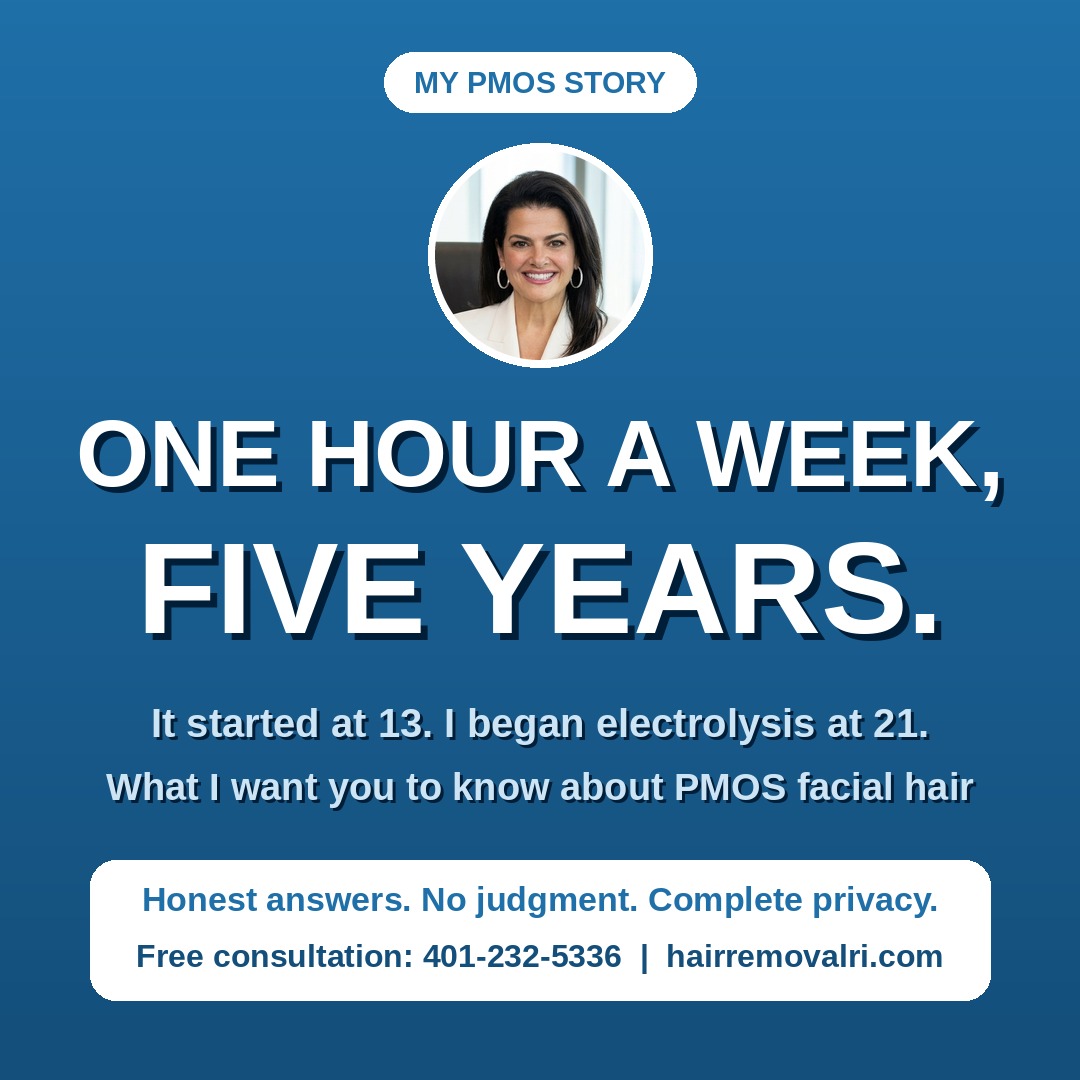
One hour a week for five years: what I want you to know about PMOS facial hair.
For years, I avoided one simple thing: letting someone kiss me on the cheek. It wasn’t that I didn’t want the affection. I knew what they would feel, because the hair growth on my face, caused by PMOS (formerly known as PCOS), was rough under the surface of my skin no matter how carefully I shaved. So I stepped back, turned my head, or found a reason to keep a little distance, and most people never knew why.
If you live with this, you may already know exactly what I mean. If you don’t, I want to tell you what it was really like, and what I want you to know now.
The shadow I covered every day
The hair growth started when I was 13 years old, and I didn’t begin electrolysis until I was 21. In those years I tried everything else. I tweezed and I waxed, but once electrolysis begins you can no longer remove the hair from underneath the skin, so shaving became my only option in-between. I shaved my face several times a day, and the dark shadow came back almost as soon as I put the razor down. I covered it with heavy foundation, layer after layer, hoping no one would look too closely.
I was always self-conscious, and the shadow was on my mind in every conversation, every photo and every room I walked into. I also carried a quiet fear that if I ever got sick and couldn’t shave and cover it every day, people would see the growth. It’s hard to explain how much space a worry like that takes up, day after day.
One hour a week, for five years
I chose electrolysis because there was no other option at the time, since laser was still in the testing stages. Electrolysis did what it does: it treated every hair, one follicle at a time, and I went one hour a week for five years.
At first, progress was painfully slow. For the first several months we never got past my upper lip, because the growth there was so dense that the whole hour went to that one small area, and we couldn’t even begin on the rest of my face. The upper lip is the most painful place to be treated, and I won’t pretend it was easy.
It was a huge commitment of money, too. I couldn’t afford it myself, and my mother paid for it. I’m grateful to her, and I also know how many people don’t have anyone who can do that for them, which means that for a lot of people the cost of treatment week after week, for years, is simply out of reach. And that was only the time and money. It was five years of arranging my life around an appointment while I still had a shadow to cover in between.
What I know now
Laser hair removal wasn’t an option at that time, but if it had been, I believe the story would have been very different. Laser treats the pigment in the hair, which means it can treat many follicles at once. In our experience, when the correct laser is used properly on dark hair, this is what the journey looks like:
- About six treatments on average for established growth, not five years of weekly hours.
- On average, about a 40% reduction after the first treatment.
- No more weekly appointments.
- No more shadow or rough skin.
Results vary with your hair, your skin and your hormones, and the timing depends on who you go to. We space our treatments according to the treatment number, from 2 to 4 months apart based on the growth cycle, because we find this very effective at minimizing the number of treatments needed, while many practices bring clients back every 4 to 6 weeks. When you’re comparing providers, ask how often they schedule treatments and how many they expect you to need.
I also want to be honest about the limits. Laser can only treat hair that has dark pigment, so it can’t treat gray, white, red or blonde hair, which is where electrolysis still has an important role, along with the hairs a laser can’t see. Many people do best with both, and the right plan depends on your hair, your skin and your history.
PMOS itself is hormonal, and hormones can keep triggering new growth, so in these cases, some people need maintenance treatments afterward. Hair removal doesn’t treat PMOS itself, so I’d encourage anyone with this condition to work with their doctor on the medical side as well.
If you’re in the middle of this right now
Here is what I want you to know:
- You have more than one option today. If someone has told you that laser doesn’t work or isn’t permanent, ask more questions before you commit to years of treatment. The FDA clears lasers for “permanent hair reduction,” and that wording doesn’t mean temporary. Read the full explanation here.
- Ask any provider which method fits your hair color, hair density, skin tone and the area being treated, and why. Ask how many sessions it will realistically take, and whether they’d refer you elsewhere if another method suited you better.
- Choose carefully. Look for a provider with real experience and the right equipment for your skin.
- Be patient with yourself. What you feel about this is real, and it was real for me.
You’re not alone in this
I know this struggle personally, and in my 41 years in this field I’ve helped many others through it. What I’ve learned is that the cost isn’t only the money or the hours but also the daily weight of feeling self-conscious, and I would never want anyone to carry that longer than they have to. I can’t tell you how many of my clients come back for their second treatment in tears, saying that “this has changed my life“.
If this sounds like you, I’d be glad to talk. Your first consultation is free, and when you step into our office you’ll find honest answers, complete privacy and genuine compassion, with no judgment and no pressure.
Schedule your free consultation: call 401-232-5336 or visit hairremovalri.com.
Suggested web address: pmos-pcos-facial-hair-removal-my-story Suggested search description: A personal story of 5 years of weekly electrolysis for PMOS (PCOS) facial hair, and what I want you to know about laser, electrolysis and choosing a provider.