



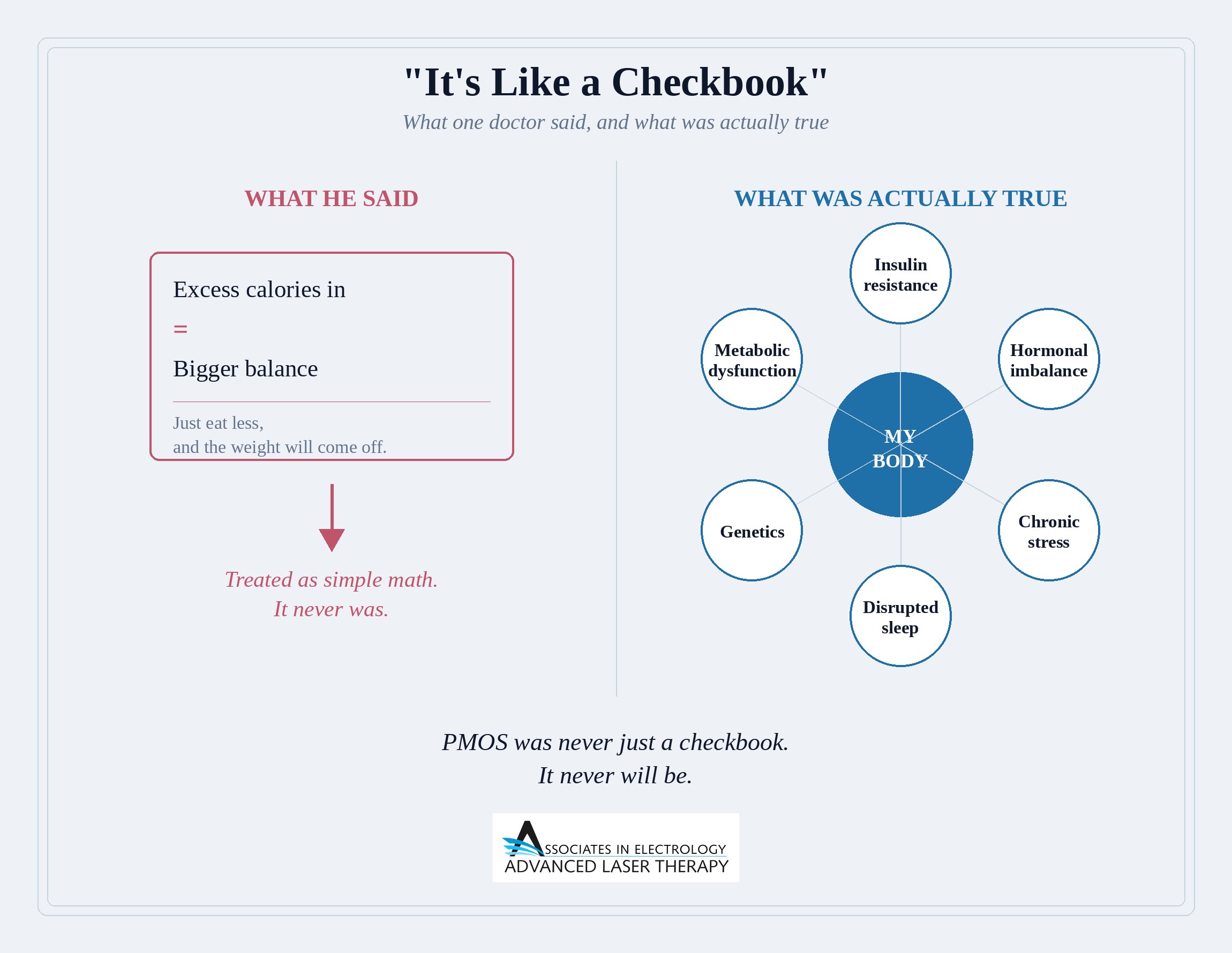
It’s like a checkbook!
I was 13 years old when I was diagnosed with PCOS — Polycystic Ovary Syndrome, now officially renamed PMOS, or Polyendocrine Metabolic Ovarian Syndrome. The name changed this past year, after decades of research made clear that this was never just an ovarian condition. It’s a complex hormonal and metabolic disorder that touches nearly every system in the body — which, looking back at my own life, explains a lot.
At an age when most girls are worrying about homework and friendships, I was dealing with excessive facial hair growth and periods that would disappear for three, sometimes six months at a time, only to return heavy and overwhelming when they finally did. I didn’t have the vocabulary for it then, but I remember feeling like my body had become something I no longer recognized, and something I couldn’t talk about with most of the people around me.
That was just the beginning.
Over the years, PMOS brought obesity I couldn’t seem to outrun no matter what I did, migraines that could level an entire day, and a kind of chronic fatigue that no amount of sleep ever seemed to fix. My moods shifted in ways that felt entirely outside my control. My self-esteem took a hit that took decades to rebuild. There was intense abdominal pain I learned to just live with — pain I later understood was coming from ovarian cysts rupturing, and, as I’d eventually learn decades later, from endometriosis as well, something no one identified for me at the time. And running underneath all of it was a constant, low hum of physical stress — the kind that comes from a body that always feels like it’s working against you instead of with you.
It took more than 30 years for doctors to officially diagnose the endometriosis. Thirty years of pain that had a name the whole time, and no one found it. Along the way, I also faced infertility, which is its own kind of grief — one that doesn’t always get acknowledged the way it should.
I share all of this not for sympathy, but because I know I’m not the only one carrying a story like this quietly. PMOS doesn’t just show up as one symptom on one lab report. It shows up in your face, your body, your energy, your mood, your confidence, your ability to plan a future — and so often, in silence, because it’s not the kind of thing that comes up easily in conversation.
For most of my life, I didn’t feel like my voice mattered in any of this. Doctors dismissed symptoms for decades. One physician, early in my diagnosis, told me weight was simply like a checkbook — the more calories I put in, the bigger the balance got. It was meant, I think, as a simple explanation. What it actually did was add another layer of shame to something that was never that simple to begin with, and it’s stayed with me all these years later. People around me didn’t always know what to say, so many said nothing at all. And I learned, the way so many of us do, to just push through quietly rather than ask to be heard. I know now how much that cost me. We need to be heard. Our voices matter — in the doctor’s office, in our relationships, and in the quiet moments when we’re just trying to explain what’s actually happening in our own bodies.
If there’s one thing several decades of this has taught me, it’s this: the people who made the biggest difference in my life were never the ones who assumed they understood what I was going through. They were the ones who asked. Who listened without rushing to fix it. Who let me have a hard day without turning it into a bigger conversation than I had the energy for.
It’s also, in a very real way, part of why I do the work I do today. Facial hair growth was one of the very first symptoms that told me something was wrong, long before I had a diagnosis to explain it. I understand, personally, what it feels like to look in the mirror and feel at war with your own body. That understanding is something I carry into every single appointment with every client who sits in my chair, whether they have PMOS or not.
If you’re living with PMOS, I see you, and I know how much you’re carrying that doesn’t show on the outside. Your voice matters — don’t let anyone, including a doctor, make you feel otherwise. Advocate for yourself, even when it’s hard, even when you’re tired of explaining. And if your doctor isn’t hearing you, find someone who will — someone who’s genuinely passionate about addressing it. If you love someone who’s living with it, please don’t assume you know what they need. Ask. Listen. Let them be heard. That alone can mean more than you’ll ever know.
And beyond PMOS, let’s all try to be a little more compassionate with each other, no matter the situation, because we never truly know what someone else is carrying. We never know whose life might be changed by our compassion, our patience, and our kindness.